



Although it is a weekend evening and the doors of the office are closed to their young visitors for today, the walls seem to be saturated with children's chatter and giggles, and it seems as if the sounds of computer games, robots, and keyboard clicks seem to still be echoing from somewhere. The imagination conjures up images of groups of children in every corner of the space captivated and enthusiastic about a variety of activities: from simply mastering Microsoft Office skills and games on a console or tablet to trying their hand at recording podcasts and programming robots. However, just as the activities offered in this space are diverse, the children who visit it are diverse in terms of their mental and physical abilities, backgrounds, and life circumstances. However, this place is not about differences but about unity around the world of technology and media. All this is for a greater goal – to overcome digital exclusion.
What exactly does the concept of “digital exclusion” or “digital divide” mean and who it can affect?
Digital exclusion is a complex issue with many definitions. It is commonly understood as affecting marginalized groups who are unable to use the internet and technology in ways that enable full participation in modern society. The COVID-19 pandemic highlighted just how important digital access has become, as more aspects of daily life moved online. In an increasingly digital world, lacking internet access or suitable devices often means being left out altogether. Moreover, according to “Identifying and understanding digital exclusion: a mixed-methods study” by G. Wilson-Menzfeld et al., digital exclusion is increasingly blurring into social exclusion. Many public services are becoming 'digital by default', and vital social processes take place primarily online.
Among the groups most affected by the digital divide are people with disabilities, especially children and young people, and people with disadvantaged socioeconomic status. They often experience additional barriers and limitations when it comes to accessing digital tools, education, and communication platforms. Based on statistics from the International Classification of Functioning, Disability and Health (ICF), taking into account all types of disabilities, there will be approximately 415,780 children and adolescents with limitations in Germany in 2022, which is about 3% of the total child and adolescent population. While there is growing awareness of the need for accessibility, digital inclusion for young people with disabilities remains uneven. Without targeted support and barrier-free environments, many youngsters risk being excluded not only from online learning and social spaces but also from essential opportunities for self-expression and skill development.
The solution – digital inclusion! But how does one do it?
This is where initiatives like “barrierefrei kommunizieren!” (communicate without barriers!) step in. Under the slogan “Begeistern und Bilden (Inspire and educate),” their project with offices in Berlin and Bonn aims to promote digital inclusion. Since 2013, it has been part of the Netzwerk Inklusion mit Medien (Network Inclusion with Media), shortly nimm!, of LAG Lokale Medienarbeit NRW e. V. in cooperation with tjfbg (Technische Jugendfreizeit- und Bildungsgesellschaft, Technical Youth Leisure and Education Association). So, most of the media center’s “barrierefrei kommunizieren!” programs are designed for people with physical or cognitive disabilities, and all the tech is adapted to their needs. On top of helping and supporting young people with disabilities, as part of the “digital dabei! 10.0” project by LAG Lokale Medienarbeit NRW e.V., they also run free media projects for young refugees. Being organized locally, the initiative is funded by the Ministry for Families, Youth, Integration, and Equality of the State of North RhineWestphalia (NRW) and is supported by partnerships through nimm!
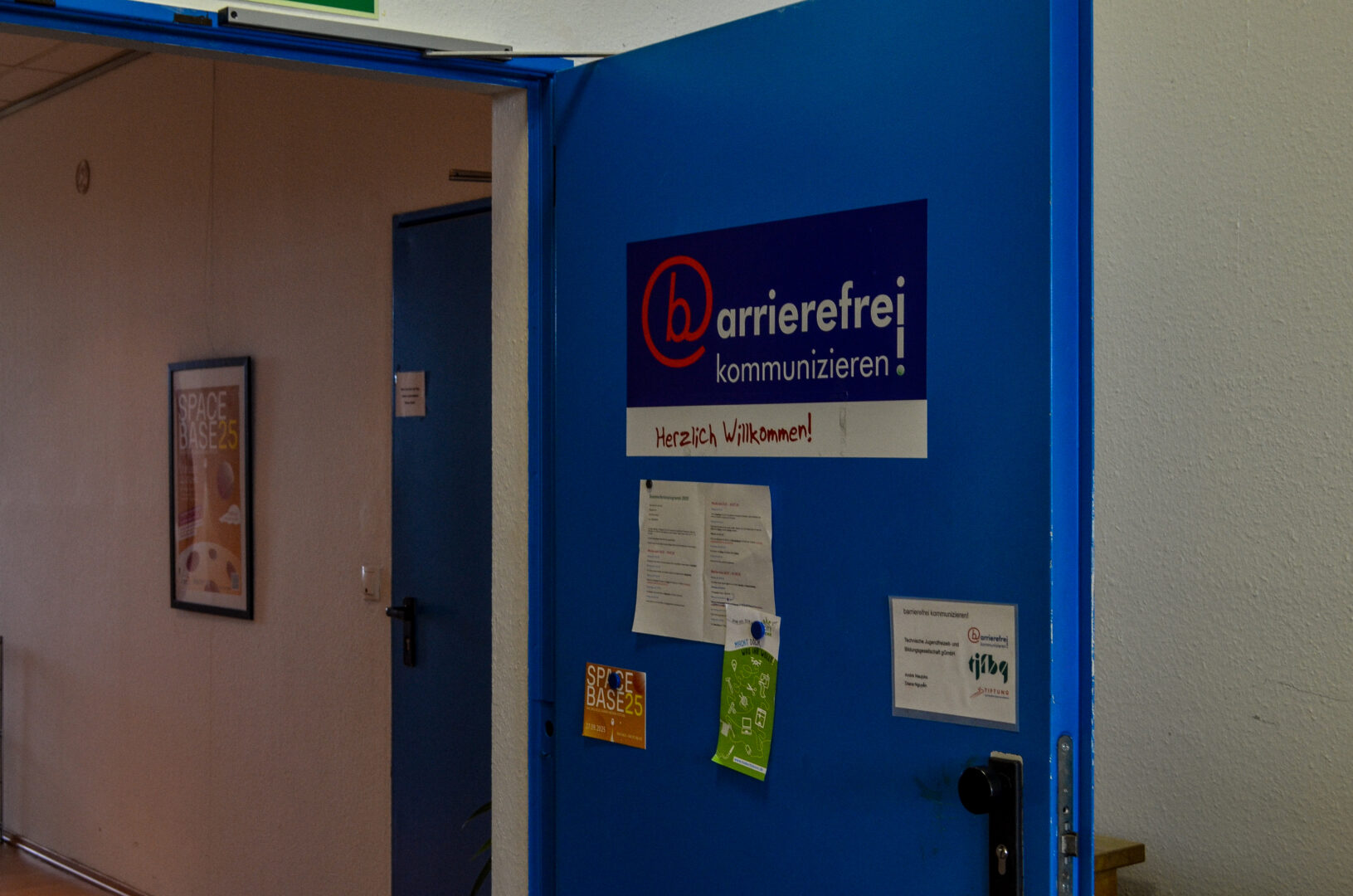
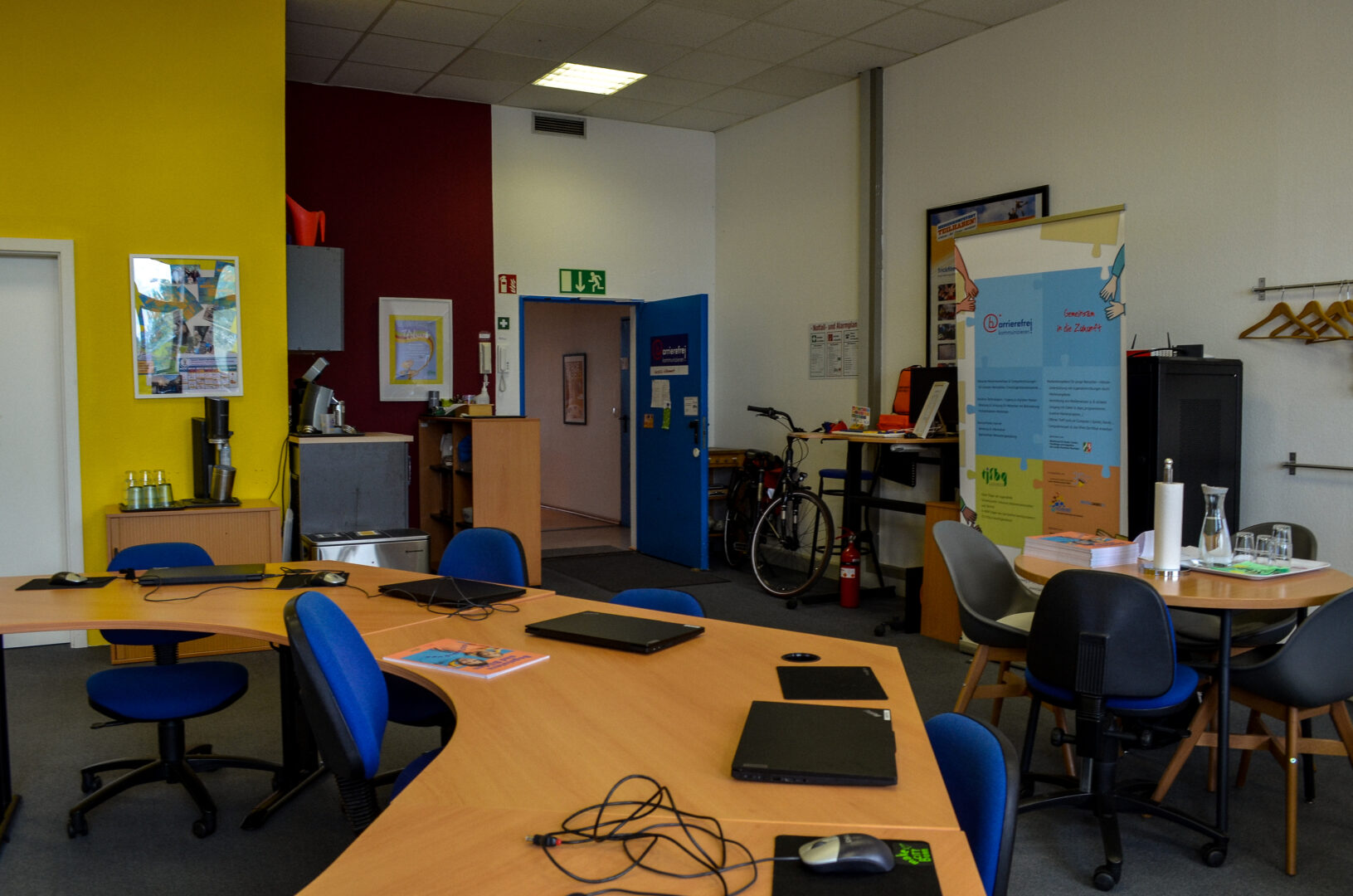
Stopping by the project office in Bonn, educators Diana Nguyễn and André Naujoks warmly welcome anyone who needs help and guidance in the digital world, as well as anyone who is simply interested in the topic of inclusion through technology and media. Even a quick glance around the room reveals how carefully this space has been designed and how many technologies are available for both regular use and for kids with certain physical or cognitive challenges. It is immediately apparent that the two-room space is divided into different zones designed for various technical and media activities for children and teenagers: there is space for working with laptops, a digital whiteboard, a 3D printer, a place to play with robots and mechanisms or even build your own, or a place to simply play video games with friends.
Another interesting detail of the interior is the sheets of paper with certain symbols hanging here and there. They are primarily intended for children with autism and are meant to evoke certain associations and provide simple visual information about the practical function of a particular area of the space. For instance, with the recent addition of new equipment to the office and the accompanying new activities that children can try out, the audio recording station has already received its own label with an adapted symbol indicating the purpose of this area. In addition, one more fascinating feature is the colorful dots scattered nearly everywhere. Initially, they appear to be mere stickers, yet Diana explains their purpose: they are intended to be pointed at with an assistive device in the form of a pen, thereby activating an audio recording of information or explanations. Such a device can be useful for individuals with cognitive or visual impairments, or with certain mobility limitations, or even language learners who wish to access information non-visually and independently.
Along with these assistive devices, the project also has a bunch of tablets that can be adjusted to fit each kid’s individual needs using assistive apps. What’s more, the project owns several types of robots that children, regardless of whether they have disabilities or not, can use to learn the basics of robotics and programming through playing. Even adults can have fun drawing different routes with blue, red, and green markers, which the Ozobot robot, reading the colored drawing, follows. Among other things, to further unleash one’s creative self, the project provides a photo booth with various props and a green screen for creating amusing photographs. Judging by the presence of such silly photos and their number on the walls of the office, this is quite a popular activity.
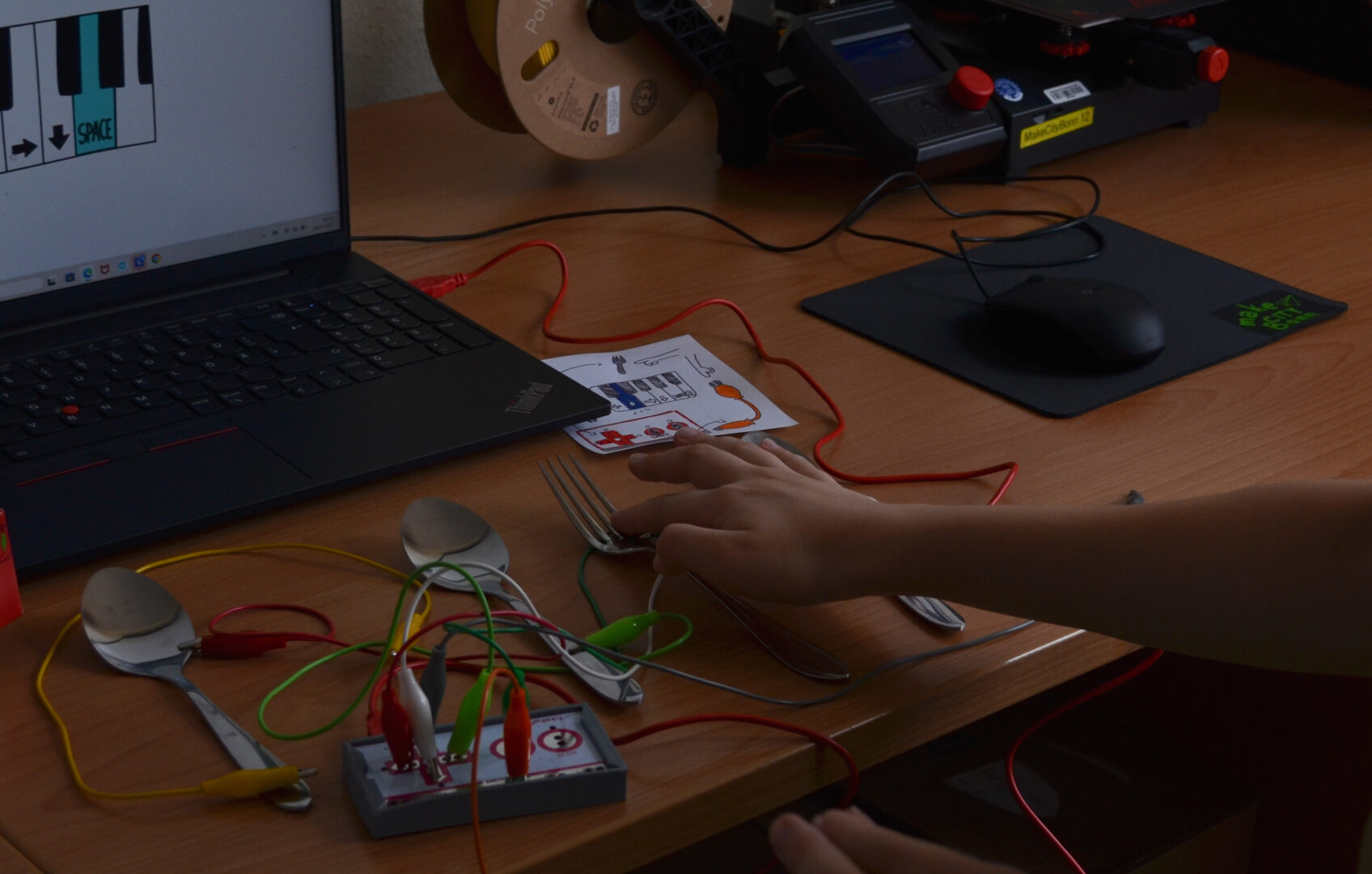
Equipped with both assistive and developmental and entertainment technology, the initiative “barrierefrei kommunizieren!” offers a wide range of hands-on digital experiences for children and young people. From creative workshops such as programming with Scratch, storytelling with app-based tools, or learning robotics with instruments such as Thymio and Ozobot, to school courses teaching computer and Office skills. Every Tuesday, young participants can also join an open media meeting to play games, get technical advice, and meet new friends – all in a barrier-free and supportive environment. However, in addition to providing opportunities for young people at its office, the project also organizes technical and educational support as well as consultations on inclusive media literacy work for youth institutions and parents. The initiative also takes on interns who have the opportunity to gain experience not only working with children and young people from different backgrounds, with and without special needs, but also to try their hand at this concept by working with them using innovative technologies and media.
However, although the main goal of the initiative is digital inclusion and teaching media literacy to the younger generation, there is another thing that the project sets out to achieve. “We want not only to teach, but also to enable children to pass on the skills they have acquired to their peers. So that they can show that despite certain limitations due to their disability or background, they can still be involved in using various technologies,” says Diana, an educator at the project center. She also shared that there are even stories of children coming to their center since they were little and, so to speak, “growing up with them,” remaining regular visitors until they graduate from school. The “barrierefrei kommunizieren!” office in Bonn also plays host to birthday parties for children who visit it. According to Diana, they are happy to provide a space for such events for families who, due to certain circumstances, are unable to hold a children's party at home or elsewhere. Also from Diana's stories, one may get the impression that this is not just a barrier-free media center for young people, but also a place where friendships are formed, ideas are born and brought to life, and where children find a comfortable space for creativity and self-expression. “A lot of things come from the children themselves,” Diana remarks about some details of the project space and the children's ideas for its accessible arrangement or even activities related to digital skills. For example, Diana commented that one of the regular young visitors and users of the media center took the initiative to organize and hold a workshop for his peers on using the audio recording station and recording podcasts.
Digital accessibility is no longer a luxury – it’s a basic right
Digital accessibility means more than just using a device – it’s about inclusive design, supportive technologies, and empowering environments that enable everyone to engage meaningfully online. Projects like “barrierefrei kommunizieren!” don’t just provide devices or training. They create an open, low-pressure space where people can explore technology without fear, ask questions freely, and build real skills. Inclusion doesn’t happen by accident – it takes spaces where people feel safe, welcome, and encouraged to learn.
However, national structural changes are equally important. In this regard, positive changes may be observed in Germany in the future with the Accessibility Strengthening Act (BFSG) coming into force on June 28, 2025, which requires all digital services and products to include accessible inclusive design. From phone apps and computers to ATMs and e-readers, everyone must meet this requirement by 2030.
While grassroots initiatives offer immediate, tangible support to individuals and show that digital participation can be accessible and fun when it’s done with empathy and purpose, long-term progress depends on systemic change. The upcoming Accessibility Strengthening Act (BFSG) marks a significant step in this direction, signaling a national commitment to digital inclusion. Nevertheless, when community- driven efforts and government policy align, the potential for meaningful change multiplies.
By Vlada Kostoglodova
Sources:
Fachstelle für Internationale Jugendarbeit der Bundesrepublik Deutschland e.V.
(2023) Child and Youth Services in Germany. Structural framework – Society: 1.1.9
Disability. URL: https://www.kinder-jugendhilfe.info/en/structural-
framework/society/disabilities
G. Wilson-Menzfeld, G. Erfani, L. Young-Murphy, W. Charlton, H. De
Luca, K. Brittain & A. Steven (2025) Identifying and understanding digital exclusion: a
mixed-methods study, Behaviour & Information Technology, 44:8, 1649-
1666, DOI: 10.1080/0144929X.2024.2368087
N. Brunotte, T. Müller (2024). New German accessibility law targets inclusive digital
products and services by 2025: challenges and opportunities for economic operators.
DLA Piper. URL: https://www.dlapiper.com/en/insights/blogs/mse-today/2024/new-
german-accessibility-law-targets-inclusive-digital-products-and-services-by-2025
tjfbg (Technische Jugendfreizeit- und Bildungsgesellschaft, Technical Youth Leisure
and Education Association, 2025). Außerschulische Angebote. Barrierefrei
kommunizieren! – Angebote in Bonn. URL: https://www.tjfbg.de/ausserschulische-
angebote/barrierefrei-kommunizieren/angebote/angebote-in-bonn
Lorem ipsum dolor sit amet, consectetur adipiscing elit. Ut elit tellus, luctus nec ullamcorper mattis, pulvinar dapibus leo.


