Offering resources to the public – at no cost – may sound like a tall order. But volunteer- led initiatives prove otherwise: The growing success of cargo bike programs across Germany showcases how commons-based solutions can be both sustainable and rooted in neighborly solidarity.
Freiburg/ Germany. Located in the southern German city of Freiburg the initiative LastenVelo has taken on the challenge of providing cargo bikes to citizens free of charge. LastenVelo Freiburg was one of the first initiatives in Germany to contribute to the transformation to a green, urban mobility in this way. Now, an increasing number of cities and even rural communities have adopted the concept. These cargo bike lending services are run entirely by volunteers who aim to offer their fellow citizens a free and eco-friendly transportation option.
From Courier to Commons
LastenVelo-Founder Robert Schneider discovered a blind spot in urban transportation while working for a bike courier service almost ten years ago.
“When we started there were about three or four cargo bikes available in the whole city of Freiburg”, says Schneider. “I was convinced that cargo bikes have enormous potential – they offer many advantages over other means of transportation, especially in urban traffic.” Schneider recognized cargo bikes as a great, compact and easily accessible alternative to cars or cramped public transportation. Free from emissions and readily available – it was not long before other Freiburg citizens started to see these benefits too and made use of the free service regularly.
What is a Common? Commons are items, places, or services made available to everyone in a community. They can be something as abstract as a legal system or as familiar as a public park, but also something more tangible – like a bike that everyone can use. While these are everyday examples of shared resources, they are rooted in the broader idea of the common good – a foundational principle of societies that aim to serve the well-being of all. Concepts like this have been explored by philosophers and statesmen, from Aristotle to Jean-Jacques Rousseau, for as long as human communities have existed. On a broader scale, the idea is tied to the very foundation of a mutually beneficial democracy.
A Bike for Errands, Events and Everything in Between
Currently, LastenVelo manages a fleet of 47 cargo bikes on the streets of Freiburg and the surrounding area. Users can select timeslots on the website and receive the code to the bike lock via email. The rest is up to them.
“The usage of the cargo bikes differs in the city and the rural communities. Many city users are lending the bikes for just a few hours to transport something from one neighborhood to another. In rural communities the bikes are regularly lent for up to three days for bike trips with friends and family and social gatherings in the countryside”, says Schneider.
The cargo bikes have been used for purposes as diverse as their users: in weddings, to carry musical equipment, pets and solar panels as well as in demonstrations to support democracy and LGBTQIA+ Rights. The bikes are not only a means of transportation but also create low-threshold opportunities.
The cargo bike services in Germany are mostly independent and fully enabled by volunteers like Robert Schneider. The purchase of new bikes is made possible by user donations and through the support of local companies in exchange for advertising. Federal projects occasionally provide additional funding to strengthen civic engagement efforts.
LastenVelo Freiburg founder Robert Schneider is pleased with how things are going: “I’m glad that the project is entirely community-driven. It allows us to implement new ideas quickly and without unnecessary bureaucracy.”
Evolving the Concept of Commons
Initiatives like free cargo bike services can also lead to new and expanded services. LastenVelo for example, opened their bike workshop to the public at no additional cost. “We need the workshop to do maintenance on our bikes. It was a natural thought to open it up to the whole neighborhood to work on their own bikes as well”, says Schneider. So far, the experience in Freiburg has been trouble free.
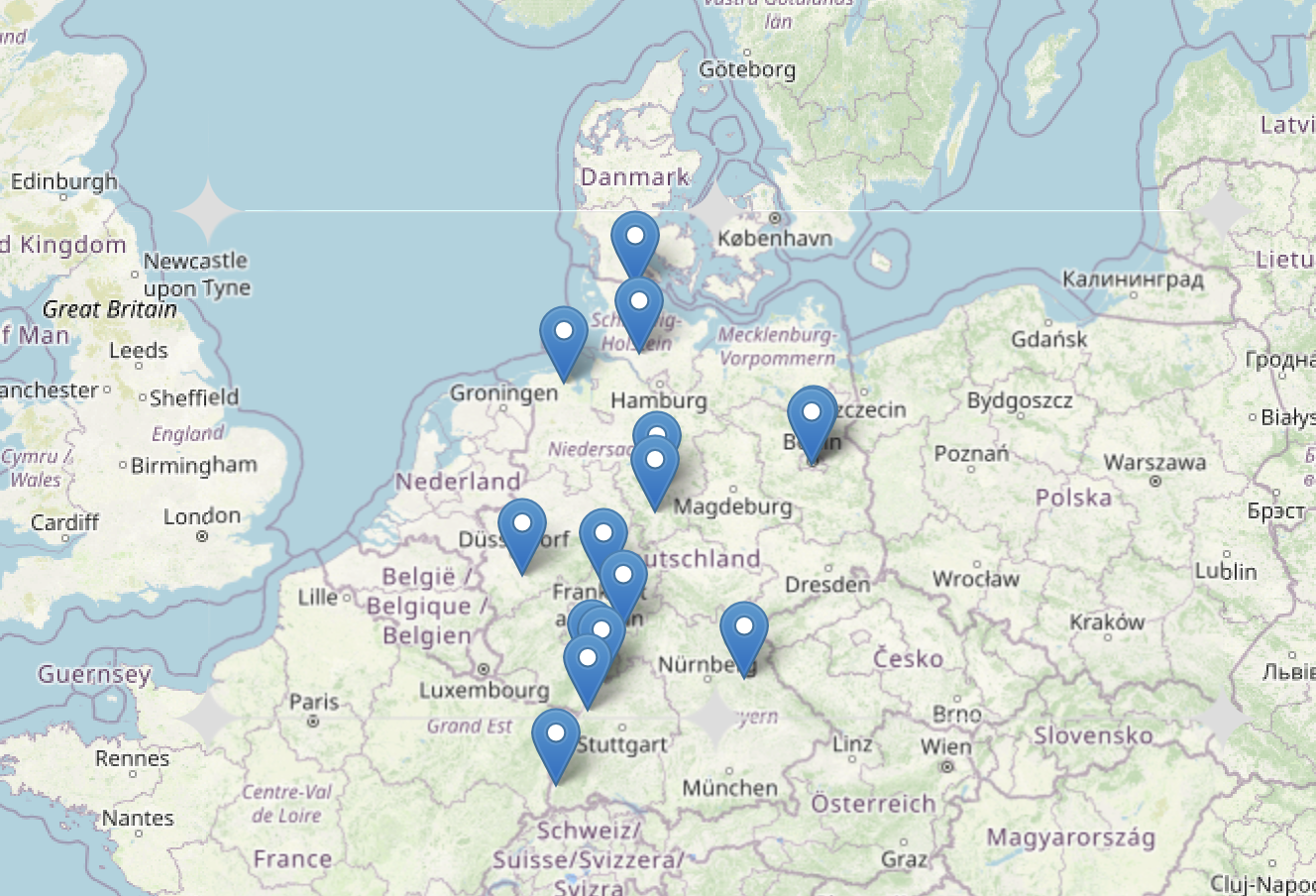
Across Germany more and more cities and communities are catching up. Platforms like “Freie Lastenräder” are giving an overview of the 160 service points across Germany, connecting the users to the services but also the volunteers who are building communities to learn from each other.
A simplified overview on the freies-lastenrad website is showcasing cargo bike
initiatives all over Germany. | Source: freies-lastenrad.org
Initiatives like these show that individuals can make a social and environmental impact – by offering simple solutions, getting involved, and building communities. It’s a concept that thrives on civic engagement: from community gardens in metropolitan areas, to foodsharing networks that fight food waste, to open archives that provide free access to art and culture.
While each initiative may appear to pursue a different goal, they are united by a shared principle: they are sustained through collective effort rather than financial profit or state control. They demonstrate that civic infrastructure can be built and maintained through local engagement and shared responsibility. In this way, commons provide not only practical benefits, but also a framework for strengthening social cohesion and rethinking how we manage public resources.
This website uses cookies to keep the site running correctly. No personal data will be stored within your session. ACCEPT
Privacy & Cookies Policy
Privacy Overview
This website uses cookies to improve your experience while you navigate through the website. Out of these cookies, the cookies that are categorized as necessary are stored on your browser as they are essential for the working of basic functionalities of the website. We also use third-party cookies that help us analyze and understand how you use this website. These cookies will be stored in your browser only with your consent. You also have the option to opt-out of these cookies. But opting out of some of these cookies may have an effect on your browsing experience.
Necessary cookies are absolutely essential for the website to function properly. This category only includes cookies that ensures basic functionalities and security features of the website. These cookies do not store any personal information.
Any cookies that may not be particularly necessary for the website to function and is used specifically to collect user personal data via analytics, ads, other embedded contents are termed as non-necessary cookies. It is mandatory to procure user consent prior to running these cookies on your website.