The European Union and the United States have struck a new trade agreement that could reshape transatlantic relations for years to come. What is included in the deal, and what can that mean for the Green Deal of the European Union as well as its climate protection commitment in the next years?
What’s in the deal?
The agreement sets a new baseline for transatlantic commerce. It includes a 15% tariff ceiling on most EU exports to the US, meaning European products shipped to America will face lower maximum import taxes than before. This can be a win for exporters in industries like machinery, chemicals, and high-end manufacturing.
Some of the finer details remain unclear, and both sides’ public statements differ on specifics. But the scale of the energy commitment alone makes the climate implications impossible to ignore.
The reason behind the deal: From Russia to America
The biggest energy importer of the EU has been Russia. With Russia’s war against Ukraine and the immediate threat that it posed to the integrity of the EU, the EU wants to shift its dependency on energy from Russia to other possible partners. This is why it has shifted from Russian pipeline gas to fracked US LNG.
What is LNG?
LNG (Liquefied natural gas) is natural gas cooled to about -162°C, which shrinks its volume by a factor of about 600, making it easier to ship across oceans. Without this process, much of the gas could only travel by pipeline.
LNG is nevertheless connected to a heavy environmental impact. Much of the US LNG is fracked shale gas, which leaks methane during extraction and transport. Methane is far more potent than CO₂ in the short term, and studies show LNG from the US can be over 6 times more climate-damaging than pipeline gas from Norway.
Why is this shift a controversial one?
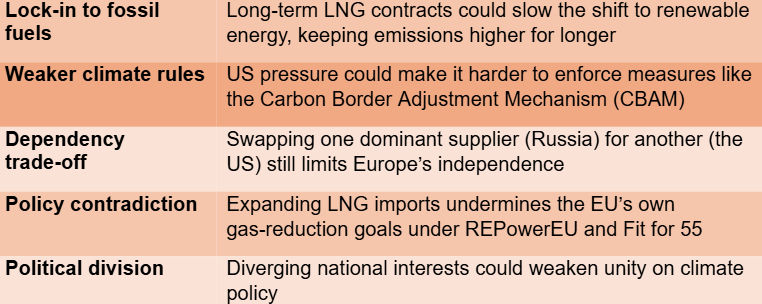
This deal according to critics shifts Europe’s dependency from Russian pipeline gas to fracked US LNG, which has a much higher methane footprint than conventional gas and risks undermining both the EU’s climate targets and its 2024 Methane Regulation.
Why making energy decisions on an EU level is difficult: The EU’s political and legal context
Energy policy in the EU is a shared competence between the Union and its member states, and in some areas, like the choice of energy sources, the EU has limited legal authority (Articles 194 and 192.2(c) TFEU). The Commission can negotiate international energy provisions, but each member state ultimately decides its own energy mix.
This division often leads to policy incoherence. Some countries welcome more LNG to diversify supply away from Russia, while others worry about locking in high-emission fuels for decades.
Copyright: Pexels/ lil artsy
Climate risks for the EU – how the European Green Deal can be negatively impacted:
Copyright: Pexels/ Volcsei Peter
Balancing security and sustainability – the EU at a crossroad
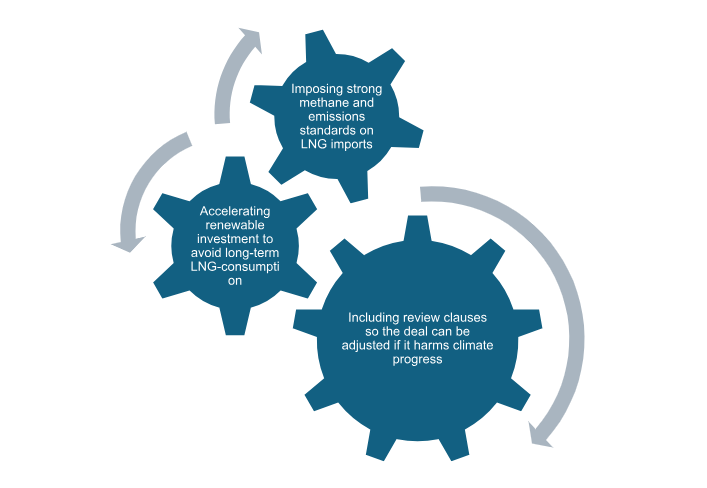
The EU’s motivation is clear: After Russia’s war on Ukraine disrupted energy supplies, Europe wants stable, friendly suppliers. US LNG offers reliability, and the tariff deal strengthens trade links. But the environmental costs are hard to ignore. Large-scale LNG use might feel like a short-term win for security, yet it risks derailing climate targets unless strict methane controls, emissions accounting, and rapid renewable expansion happen alongside it.
How can the EU still hold on to the commitments of the Green Deal:
Because parts of the agreement are still unclear, especially beyond the energy commitments, the European Parliament and member states will play a decisive role in implementation. The EU can still protect the continuation of the Green Deal.
The new trade deal undeniably deepens the EU-US partnership. The question is whether Europe can use that partnership to speed up the green transition or whether, in chasing energy security, it risks locking itself into another fossil-fuel trap.
This website uses cookies to keep the site running correctly. No personal data will be stored within your session. ACCEPT
Privacy & Cookies Policy
Privacy Overview
This website uses cookies to improve your experience while you navigate through the website. Out of these cookies, the cookies that are categorized as necessary are stored on your browser as they are essential for the working of basic functionalities of the website. We also use third-party cookies that help us analyze and understand how you use this website. These cookies will be stored in your browser only with your consent. You also have the option to opt-out of these cookies. But opting out of some of these cookies may have an effect on your browsing experience.
Necessary cookies are absolutely essential for the website to function properly. This category only includes cookies that ensures basic functionalities and security features of the website. These cookies do not store any personal information.
Any cookies that may not be particularly necessary for the website to function and is used specifically to collect user personal data via analytics, ads, other embedded contents are termed as non-necessary cookies. It is mandatory to procure user consent prior to running these cookies on your website.