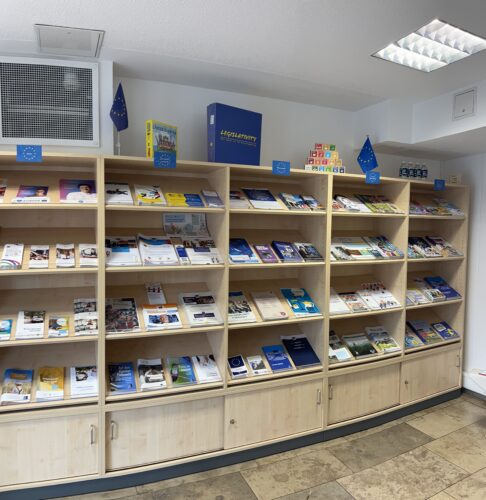
Questions, complains, concerns: In over 400 EUROPE DIRECT Centres across the continent, citizens of the EU can find answers to their questions about the EU. What exactly do these centers offer, where are the limitations and which concerns do people address there?
Trains head off into the distance, whilst below, the light-up text reading ‘ESSEN – Mitten in Europa’ (English: ‘ESSEN – in the middle of Europe’) adorns Essen Central Station, Germany. Opposite, you’ll find another nod to Europe: since 2013, the city has been home to one of the more than 400 EUROPE DIRECT centres across Europe.
What are EUROPE DIRECT Centres?
“Essentially, it’s an EU-wide network. It’s funded by the European Commission with the aim of providing education on European policy,” Lena Borgstedt from the EUROPE DIRECT Essen teamexplains. She adds: “It’s about informing people locally: How does the EU work? Where does it have the power to act, and where doesn’t it? How does it affect daily life here locally, and how do citizens benefit from the EU?”, directly linked to the question of how one can get involved in the EU. EUROPE DIRECT thus serve not only as and information centre but also as an action centre. As such, EUROPE DIRECT is not merely a point of contact with staff on hand; the team sees the core of its work primarily in educational events on European policy, ‘flying office’ initiatives, discussion forums, and providing information on social media – all aimed at reaching out to people and engaging them in conversation.
The aim is to show what the EU does and how people can get involved. Nils Ole Haar adds that this is the key focus of EUROPE DIRECT Essen: “to bring the EU to Essen.”
Meet the Team
Lena Borgstedt is the project manager at EUROPE DIRECT Essen and is in direct contact with the European “My role is to liaise with the Commission, acting as a link, and also to drive the project’s strategic development.”
Nils Ole Haar heads the Office for European Affairs, International Relations and Sustainable Development at the City of Essen, which is where the EUROPE DIRECT Essen is What makes the EUROPE DIRECT Essen particularly unique is that it is operated by the City of Essen itself.
Lennart Balke is the point of contact at the visitor centre and is therefore responsible for dealing with visitors’ questions and enquiries. He is also responsible for events involving schools/ educational institutions in general.
Ann-Kristin Grobe is responsible for public relations (e.g. social media channels) and networking. She also helps to organize events.
What kinds of matters can people approach EUROPE DIRECT about?
“You can come to us with any question you have about the EU,” says Lena Borgstedt. This isn’t just about political education in the sense of ‘How does the EU work?’, but also about specific topics, such as funding schemes.
As Lennart Balke explains, citizens come to EUROPE DIRECT in Essen with a wide variety of enquiries. A few examples include finding out about roaming charges or consumer protection, particularly with regard to sustainability and online shopping; teachers ask for teaching materials; and young people seek information on mobility, such as Erasmus and international career paths.
“I think that the way people think about the EU and the extent to which the EU is a part of everyday life has changed over the generations,” says Nils Ole Haar. “That’s what makes it so interesting: seeing just how much of the EU is all around us.” He also emphasizes how important it can be to put major issues into a local context: “Some people simply pop in to find out what the EU has to do with their town. That is fascinating to many people.”
“The EU is a complex subject. Even we don’t know everything about every detail,” Borgstedt admits, acknowledging the limitations of EUROPE DIRECT. At such a point, it is EUROPE DIRECT’s role to refer people on: “We then say: ‘We’re not experts in this area, but we know of organisation XY, which can help or provide further information’, and we refer them there.” EUROPE DIRECT reaches its limits, for example, when people seek legal advice or, as Haar adds, when they ask for voting recommendations, particularly in election years. In such cases, it is, of course, EUROPE DIRECT’S duty to remain neutral. Furthermore, enquiries sometimes pile up at the centre in Essen, particularly from schools, “and we simply have a limited capacity,” as Borgstedt explains.
EUROPE DIRECT and the connection to the EU
“The Commission tells EUROPE DIRECT centres: ‘These issues are important to us’,” explains Lena Borgstedt. As such, the centres are being assigned priority themes as part of their newly approved funding periods. As Ann-Kristin Grobe and Lena Borgstedt explain, the current focus is on combating disinformation and promoting media literacy. That said, the EUROPE DIRECT offices still have plenty of scope to adapt to local needs and get creative, from discussion formats to poetry slams and treasure hunts.
In its work, the team encounters people with a wide variety of views on the EU, particularly when they are out and about in pedestrianized areas. “We meet a wide range of people, including Eurosceptics. Every now and then, critical questions occur, such as: ‘Do we even need the EU?’” Ann-Kristin emphasizes that this is precisely what she enjoys about her work: engaging in conversation with a wide variety of people and perspectives. However, within the broader context of the political landscape, public awareness of the EU is changing in a distinctly positive way, particularly regarding geopolitics and security, as Nils-Ole Haar observes: “One thing that has really struck me is that the EU has become much more prominent in urban society since Brexit and the war of aggression against Ukraine. “The feedback we receive is much more often about what the EU offers and the benefits it brings.”
This website uses cookies to keep the site running correctly. No personal data will be stored within your session. ACCEPT
Privacy & Cookies Policy
Privacy Overview
This website uses cookies to improve your experience while you navigate through the website. Out of these cookies, the cookies that are categorized as necessary are stored on your browser as they are essential for the working of basic functionalities of the website. We also use third-party cookies that help us analyze and understand how you use this website. These cookies will be stored in your browser only with your consent. You also have the option to opt-out of these cookies. But opting out of some of these cookies may have an effect on your browsing experience.
Necessary cookies are absolutely essential for the website to function properly. This category only includes cookies that ensures basic functionalities and security features of the website. These cookies do not store any personal information.
Any cookies that may not be particularly necessary for the website to function and is used specifically to collect user personal data via analytics, ads, other embedded contents are termed as non-necessary cookies. It is mandatory to procure user consent prior to running these cookies on your website.