


By Sina Nobakht, Julia von Ammon, and Jürgen Stein
On 2 November 2020, a terrorist attack in Vienna’s historic Jewish quarter left four people dead and more than twenty injured. Today, a modest memorial located near the attack site at Desider-Friedmann-Platz marks the place where the tragedy unfolded, quietly integrating remembrance into the everyday life of the city.
Memorials are more than objects in public space. They reflect how a city chooses to remember its past, whose stories are preserved, and how those stories are shared with future generations. Vienna’s center is home to memorials of different sizes, styles, and historical significance. Some dominate public squares and parks, while others remain almost invisible to passersby. Together, they tell stories of triumph, tragedy, resistance, persecution, and loss. They also raise another important question: how does a city decide what deserves to be remembered and how? And does the impact of a memorial depend on its size or on the meaning it conveys?
Many pedestrians pass by without realizing its significance. For an event that shocked Austria, claimed lives, injured dozens of people, and left lasting scars on the city, the memorial raises an important question: Is a small memorial enough for such a significant event?
Who decides how Vienna remembers?
To better understand Vienna’s approach to remembrance, the city’s advisory board for the erection of memorials and commemorative markers provides some insight into how memorials are created. Most memorials are not initiated by the city itself but are proposed and funded by private individuals, associations, committees, or district cultural initiatives. The City of Vienna primarily oversees the preservation of existing monuments. “Vienna’s public space is already densely populated with sculptures, plaques, fountains, and commemorative markers,” the advisory board explains. “As a result, proposals for new memorials are reviewed by an independent advisory board consisting of experts in history, architecture, culture, and urban planning.” The board adds that “historical relevance, artistic quality, and suitability for the surrounding environment all play a role in determining whether a project moves forward”. The board’s guidelines reflect a broader philosophy: memorials are not simply markers of the past but reflections of how contemporary society chooses to engage with its history. Rather than filling public spaces with increasingly larger monuments, Vienna often favors a more measured approach that prioritizes meaning, context, and integration into the urban landscape.
Yet this approach raises another question: if remembrance depends on engagement, what happens when a memorial remains unnoticed?
Making remembrance visible
For sculptor Talos Kedl, who created the memorial dedicated to the victims of the 2020 attack, visibility was an important consideration in its design. His perspective echoes some of the ideas expressed by the city.
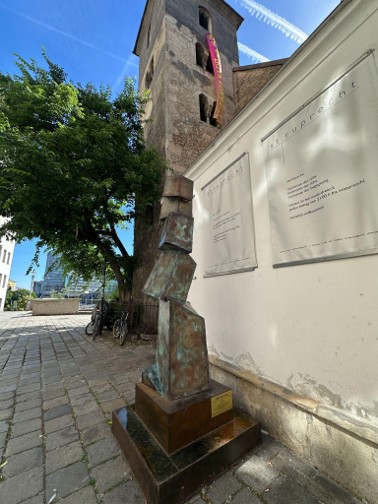
Kedl said that the memorial’s size was a deliberate choice. He explained that it was designed to be visible and attract attention without overwhelming viewers. In his view, a memorial should encourage people to engage with it, reflect on its meaning, and actively interpret its message rather than simply consume it as another object in public space. For Kedl, memorials play an important role in the collective memory of society, whether in a large city or a small community. Their purpose is not only to commemorate the past but also to help people learn from it, resist forgetting, and contribute to a better future. Looking back several years after the memorial’s installation, he believes that its size, location, and overall design continue to fulfill that purpose. “Remembrance that goes beyond architecture. The effectiveness of a memorial may not be determined solely by how large or visually striking it is. Instead, it may depend on whether it encourages people to stop, ask questions, and connect with the history it represents,” said Kedl.
At the same time, visibility remains a challenge. Vienna is a city rich in history, and its streets contain countless reminders of different eras, communities, and events. Some memorials naturally attract public attention, while others blend into the background of everyday life. Large memorial projects often become landmarks in their own right, while smaller plaques and monuments can easily be overlooked by residents and tourists alike.
This raises a broader discussion about the coexistence of memory and daily life. Vienna’s streets are not museums; they are living public spaces where people work, study, shop, and socialize. Memorials therefore occupy a space between remembrance and routine. Their challenge is not only to preserve history but also to remain meaningful within the rhythm of contemporary urban life. Perhaps, then, the question is not whether a memorial is large enough, but whether it succeeds in keeping a conversation alive. Public awareness, education, guided tours, digital archives, and community engagement may ultimately shape collective memory more effectively than size alone.
Neither the city nor the artist offer a definitive answer to whether small memorials are enough for major historical events. However, together their responses suggest a different way of thinking about remembrance. Memory is not created by monuments alone. It is sustained through public discussion, education, and the willingness of society to continue engaging with difficult chapters of its history. For cities like Vienna, finding a balance between creating spaces that help citizens reflect and ensuring that important memories are not lost in daily life will always remain a challenge.