


By Julia Hofer and Jonas Geisler
What is the first thing that comes to your mind if you hear “Munich”? The Oktoberfest? Beer? Maybe the football club? Or is it that about 50% of its inhabitants are migrants or have a migrant background (meaning they or at least one parent immigrated or were born without German citizenship)? Most people probably do not think about this aspect. Today people from over 180 countries live in Bavaria’s capital city. So, why is the public mostly unaware of Munich’s diversity? And how could it be made more visible?
Whereas people who migrate from one country to another often face commonly known and discussed issues such as alienation and loss of identity as well as discrimination and racism, there are other aspects that may be of importance to migrant communities but do not get as much public recognition. Similarly, just as many people are unaware of the extent of multiculturalism within Munich, migrants may struggle with finding a community within and outside of their culture and find that their culture is not represented or even fetishized at their new place of residence. To address these issues, there are organisations that try to guide their members through the hardships of migration or exile and have the goal to support the visibility of underrepresented cultures. Nonetheless it is crucial to discuss both the issues as well as the way they are dealt with. If they even exist, are the representations genuine or gimmicky? Do people get to live out their cultural identity without compromising their future in a new region of the world?
Munich’s migrant organisations
One central institution in the cultural landscape of migration in Bavaria’s capital is Morgen e.V, an umbrella organisation which unites and represents over 100 migrant communities. With their work, they support the projects of their members and by doing this strengthen the cultural representation of different communities. But they also host a few cultural events with diverse programmes in which members from different communities participate side by side. The Fairytale Festival is just one example for these events and unites people from a multitude of linguistic and cultural backgrounds.
One of the 19 member organisations that took parts in last year’s Fairytale Festival is the Kurdische Gemeinde München e. V.. Its goal is to “give a sense of belonging”, especially to the youth. Since their founding in 2020, they work on different projects with equality and visibility being their main focal points. The founders work hard to create three yearly events surrounding Kurdish culture and bring positivity to those with generational trauma. They try to unite heritage with a future in Germany through multilingual activities. Especially important: their work with the police, combating and “correcting stereotypes” as well as showing the Kurdish youth that they have equal rights. Alongside protecting and maintaining the Kurdish heritage, they also highlight the importance of adapting, offering courses to learn German and organising events at which people from different cultures get together. “We cannot live here and only live in our culture“, one of the founders points out.
Another part of this collective of organisations is GOROD, which was founded in 1998 as an association of Russian-speaking migrants within Munich. Its building houses a theatre, a Ukrainian bookstore and a sewing area in which they offer language courses and, most importantly, a place for community. As a member of Morgen, GOROD also works in exchange with other communities and organisations. For example, they provide their rooms for the dance rehearsals of the Kurdische Gemeinde and hosted the above-mentioned Fairytale Festival last year.

All of this sounds as if migrant communities have many opportunities to live and present their culture as part of Munich’s cultural landscape. But even if there is already a lot going on to support the visibility of such underrepresented communities, “it could be so much more”, as “Morgen’s” project manager Ilya Galle emphasizes. According to him, there are four big problems that their cultural work faces.
The problems...
As non-profit associations all of the above-mentioned organisations as well as most of their kind are in need of government funding. Two of the four main problems arise from these circumstances. The first one is a shared struggle of all cultural institutions: they must compete for a budget that is already frequently being cut. But there is more to this. Whereas big institutions that are more visible are prioritised when it comes to the distribution of funding, smaller, less represented organisations are often overlooked. For example, the “Kurdische Gemeinde” does not even have rooms of their own.
As is obvious from the two problems explained above the issues migrant cultural work is confronted with are mostly interdependent. Thus, it is no surprise that the third problem that Ilya Galle mentioned is also connected to dependency on governmental structures. Germany, including Munich, is well known for its bureaucracy and the cultural sector is no exception to this. But although this is already a problem in general, migrant cultural organisations are particularly affected by it. Because they get less funding, they cannot employ specialists to do this work for them. Actually, most of the people that work at these organisations do it in their free time. This is the origin of a vicious circle where less funding causes fewer opportunities to apply for funding. The only way to escape this dynamic is a lot of pro bono work. The limited visibility of the migrant cultural organisations causes them to struggle with their goal to get better represented. But what happens in a case where they become visible? The fourth problem is located in the process of presenting one’s culture. Showing one’s “foreign” culture in Germany always carries the risk of becoming a victim of what Ilya Galle calls “Kulturalisierung.” By this he means a form of stereotyping that reduces a culture to its folklore and consequently perceives it as strange and exotic. This idea of exoticisation must be kept in mind when aiming for visibility and showcasing one’s cultural festivities. There is a fine line between the simple staging in accordance with how others perceive a culture and actually offering room to explore heritage and teach others about it. But how can culture be conceptualised and realised with this in mind?

... and solutions?
In June 2026, Morgen organised its annual Culture Festival but this year something was different. For the first time, the Culture Festival was not its own event hosted by Morgen and its member organisations. Instead, the association got a stage as part of the ZAMANAND, which is a big downtown street festival. This development shows how migrant communities and their cultural activities are gaining representation in the “mainstream” cultural landscape of the city. The founders of the Kurdische Gemeinde also recollect many instances of gratitude for their work and the visibility it generates.
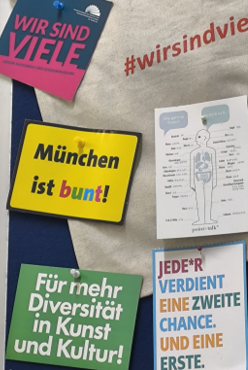
It also seems as if the city administration has reacted to the problem of the shortage of funding for smaller cultural organisations. In 2025, the budget of the cultural sector has increased, and most cuts were shifted to the well-established institutions.
Despite the aforementioned struggles, it can still be said that the landscape for immigrant culture is growing as well as becoming more diverse and more supportive throughout time. The hard work of the different migrant organisations seems to pay off. But, looking at the problems mentioned above, there is still room for improvement, and achiving it will again need commitment and hard work until there is a Munich where everyone is represented. As the founders of the Kurdische Gemeinde emphasize:
“Do not underestimate one person’s power. Do something!”