


By Julia Spiekerkötter, Dat Hoang, and Julia Hofer
Museums are not neutral spaces. Across Europe, institutions are being questioned for holding artefacts that were acquired under colonial, exploitative, or otherwise problematic conditions. What used to be framed as scientific collecting is now being reassessed in light of power imbalances and historical injustice.
This shift is also visible inside museums themselves. Institutions are under pressure to explain where their objects come from, how they were acquired, and whether they should remain on display at all. Transparency, restitution and new forms of presentation are becoming central to this process.
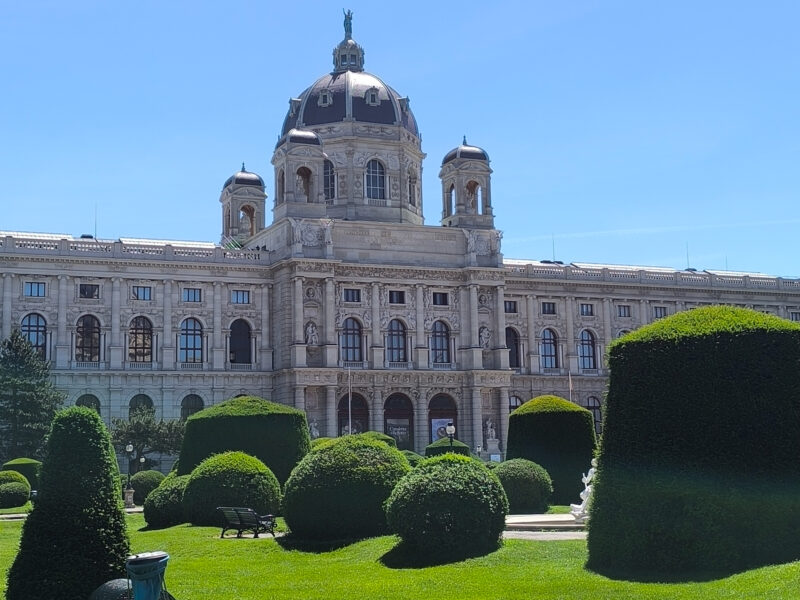
Vienna is not an exception. A current exhibition at the Naturhistorisches Museum Wien (Natural History Museum Vienna) shows how this can look in practice.
Transparency Instead of Celebration
With over 30 million objects and a collection history going back to 1750, the Naturhistorisches Museum Wien is one of the largest scientific museums in Europe. Instead of marking its 150th anniversary with a celebratory exhibition, the museum chose a different approach.
The special exhibition “Gutes Sammeln, Böses Sammeln” (Good Collecting, Bad Collecting) focuses on the practices behind the collection itself.
“We didn’t want a purely celebratory show,” says curator Dr. Anna E. Weinmann. “Collecting has positive aspects, but also difficult ones. Both should be visible.”
The exhibition is structured to make visitors aware of these contradictions. At the entrance, a cabinet of curiosities presents a dense mix of unusual objects, placed opposite the historical exhibition catalogue from the time of Maria Theresia. Inside, the space is organized in a grid, creating order while also pointing to gaps and imbalances. Some of the unique items are accompanied by audio contributions that present different perspectives on their value. Scientific, financial and historical viewpoints intersect. This shifts attention away from the object as a neutral exhibit and towards the conditions that shaped it.
Elisabeth Salinger, a visitor to the exhibition from Vienna, said: “I think it’s important that the history is told in both directions and that both sides of collecting are shown. The additional context makes many of the objects even more interesting.”
Alexander Regner, a tourist from Augsburg, Germany visiting Vienna, discloses: “I find the topic highly relevant, well beyond Vienna or the German-speaking context. Many of the ways museums acquired objects in the past are now viewed more critically, as perspectives on these ethical questions are changing. This certainly applies to many museums. I appreciate the self-critical approach taken by the Natural History Museum in Vienna.”

Context over Neutrality
Some examples illustrate how norms have changed over time. Stones taken from the pyramids of Egypt by European tourists are shown as part of the exhibition. What would now be seen as destruction of cultural heritage was once customary practice and not widely questioned.
Other cases leave less room for interpretation. Objects connected to sites such as the Gusen concentration camp are only ever shown with clear contextualization. Presenting them without explanation would not be acceptable, Weinman clarifies. “There is often no clear line,” Weinmann says. “But in some cases, the ethical dimension is obvious.”
But the challenge goes beyond museum walls. The term Raubkunst (looted art) does not even exist in Austrian law, making decisions about disputed objects far from straightforward.
Provenance Research
Historically, collecting was closely linked to exploration and scientific ambition. European researchers relied on global networks that were shaped by colonial structures. Many objects entered museum collections under these conditions.
Today, this history is being re-examined. Provenance research plays a central role in this shift. At the same time, this research remains uneven. Unlike the systematic frameworks established for Nazi-looted art under the Austrian Art Restitution Act (Kunstrückgabegesetz), provenance research on colonial collections is often conducted on a case-by-case basis and as part of curatorial work rather than through a standardized process.
At the Naturhistorisches Museum Wien, this work is ongoing. Two restitutions of historical objects have already taken place. In both cases, human remains were returned for burial to their communities of origin in Hawaii and New Zealand, in cooperation with local institutions. In the anthropological department, provenance researchers are investigating archival material to reconstruct the origins of objects and the circumstances of their acquisition.
“There are always new findings,” Weinmann says. According to Weinmann, the approaches developed in the special exhibition are now set to be gradually integrated into the museum’s permanent displays.
Legal Gaps and Constraints
Restitution is shaped not only by ethical considerations, but also by the limited legal framework.
In Austria, the 1998 Art Restitution Act regulates the return of artworks looted during the Nazi period. Research teams investigate provenance and a commission decides on possible restitutions. Federal museums are under particular scrutiny in this context. Objects held in the collections of state museums are formally owned by the state, while museums act as custodians. At the same time, many countries still struggle to establish clear legal frameworks for dealing with these holdings.
For objects with colonial histories, there is no comparable legal basis is Austria. An extension of the existing law to colonial contexts is currently not provided, as legislators point to fundamentally different historical and legal conditions. At the same time, concrete cases show how closely some objects are tied to colonial violence. For example, parts of the African collections in Austrian museums, particularly objects from the Kingdom of Benin, are directly linked to the British military campaign of 1897 and were brought to Europe in that context.
As a result, restitution processes are often slow and complex. They involve negotiations between institutions, governments and communities of origin, often with incomplete documentation.
The French National Assembly agreed on a new legal framework in April 2026 aimed at facilitating the restitution of colonial artefacts. In recent years, countries such as Algeria, Mali and Benin have formally requested the return of cultural objects from France. The new regulation applies to items that entered French collections between 1815 and 1972. It comes nearly a decade after President Emmanuel Macron pledged to return African cultural heritage.
The Future of Collecting and Exhibiting
Even without clear legal frameworks, museums are changing how they present their collections.
At the Naturhistorisches Museum Wien, the exhibition brings internal debates into the public space. Questions once handled within the institution now shape the exhibition itself.
According to curator Dr. Anna E. Weinmann, this more open approach to ownership and provenance also enables digital formats such as 3D scans and models of unique objects. These allow museums to present items even when they no longer hold the original. “In the future, museum research will work more closely with digital forms of presentation. I think both will coexist in exhibitions, digital and physical objects,” she says.
Museums are undergoing a broader shift away from the idea of neutrality. Exhibitions like “Gutes Sammeln, Böses Sammeln” make this visible by foregrounding the conditions under which collections were formed. As legal frameworks lag behind, museums are increasingly defined not by what they hold, but by how they contextualize and question it.